
La ecología integral exige una nueva antropología
Barra lateral del artículo
Contenido principal del artículo
Resumen
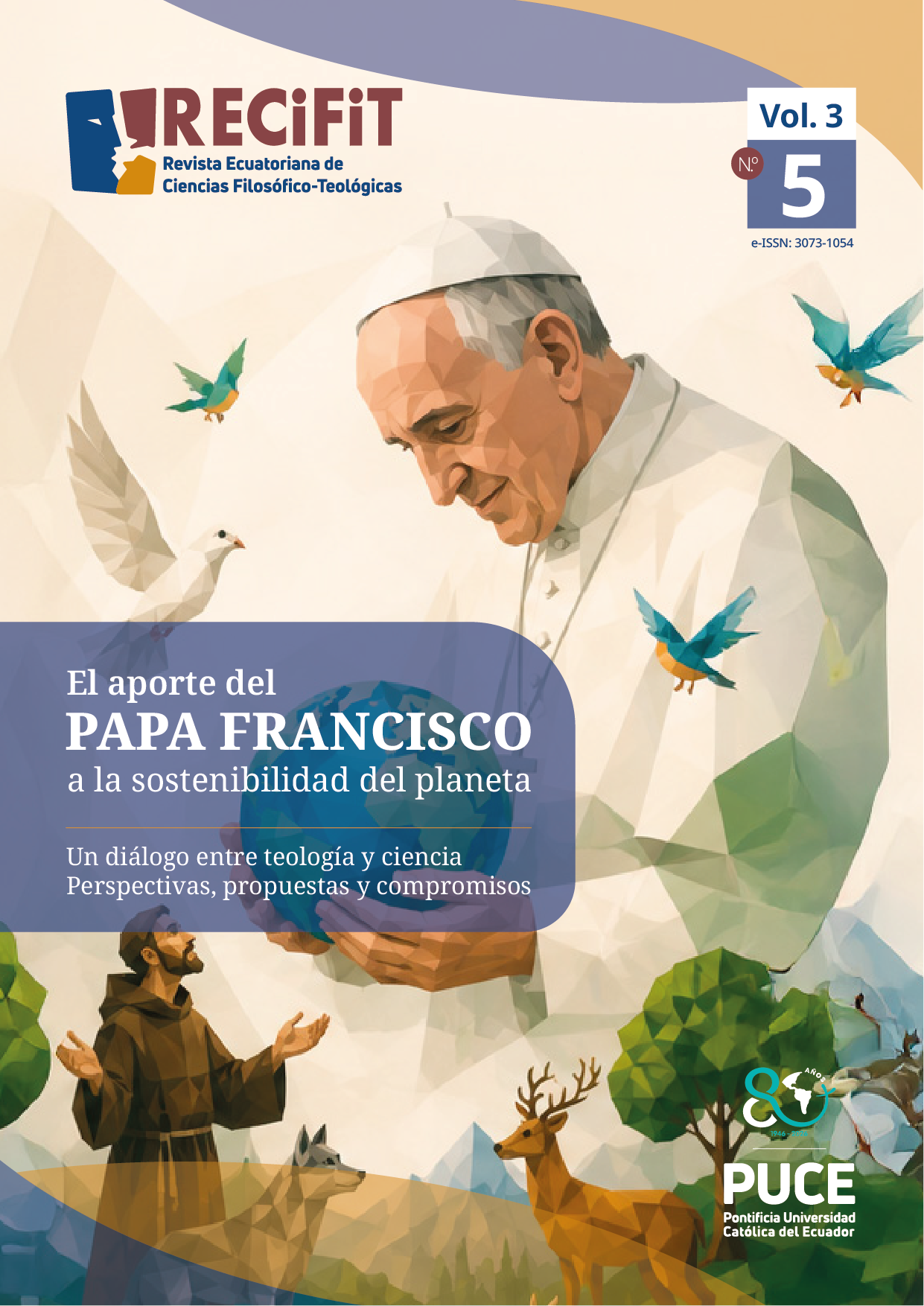
La fragmentación antropológica y el antropocentrismo constituyen algunas de las causas estructurales de la crisis ecológica contemporánea. La visión que sitúa al ser humano como centro de la creación ha favorecido formas de explotación de la naturaleza que han contribuido al surgimiento del Antropoceno. Frente a esta realidad, la encíclica Laudato si’ desarrolla una reflexión crítica sobre sus implicaciones ambientales, sociales, éticas y espirituales. En diálogo con esta propuesta, el presente trabajo plantea el ontoecocentrismo como un paradigma que puede contribuir a la realización de la ecología integral promovida por el papa Francisco. Esta perspectiva coincide con otras corrientes que subrayan que todo está conectado y que, por tanto, resulta necesario salvaguardar el principio de inter-in-dependencia. Desde esta comprensión, la realidad es entendida como cosmoteándrica, donde las dimensiones divina, humana y material se constituyen de manera relacional. Ello permite superar las pretensiones de superioridad y dominio, afirmando el valor intrínseco de cada ser sin diluir sus diferencias. En este sentido, la interrelación constituye un elemento fundamental para promover respuestas sistémicas, glocales y dialógicas frente a la crisis ambiental, social, ética y espiritual. Se concluye que la realización de la ecología integral exige una conversión antropológica capaz de superar el antropocentrismo y asumir una corresponsabilidad orientada al cuidado de la casa común, la reconciliación y el bien común planetario.
##plugins.themes.bootstrap3.displayStats.downloads##
Detalles del artículo
Declaración de disponibilidad de datos
No aplica
Sección

Esta obra está bajo una licencia internacional Creative Commons Atribución-NoComercial-CompartirIgual 4.0.
Licencia de Acceso Abierto
La Revista Ecuatoriana de Ciencias Filosófico-Teológicas adhiere al modelo Acceso Abierto en el que los contenidos de las publicaciones científicas se encuentran disponibles a texto completo libre y gratuito en Internet, sin embargos temporales, y cuyos costos de producción editorial no son transferidos a los autores. Esta política propone quebrar las barreras económicas que generan inequidades tanto en el acceso a la información, como en la publicación de resultados de investigaciones.
Cómo citar
Referencias
Amo, R. (2019). Fundamentos de ecología integral. Estudios eclesiásticos, 94(368), 5-37. https://doi.org/10.14422/ee.v94.i368.y2019.001
Bauman, Z., Rosenberg, M. y Arrambide, J. (2002). Modernidad líquida. Fondo de Cultura Económica.
Boff, L. (1996). Ecología: grito de la tierra, grito de los pobres. Trotta.
Boff, L. (2008). La opción-Tierra. Sal Terrae.
Butler, J. (2015). Notes toward a performative theory of assembly. Harvard University Press.
Chung H.K. (2004). Introducción a la teología femenina asiática. Verbo Divino.
Cormie, L. (2021). Transhumanidad, poshumanidad, antropoceno. Horizontes cambiantes de ignorancia y conocimiento, realidad y posibilidad, esperanza y fe. Concilium, 391, 435-448.
Crutzen, P. y Stoermer, E. (2000). The ‘Anthropocene’. Global Change Newsletter, 41, 17-18.
Farah, M.A. La ecología integral y la sostenibilidad, en S. Sierra y C. Novoa (eds.). Diez años del pensamiento social del papa Francisco, 283-292. Editorial Javeriana.
Foucault, M. (1991). Tecnologías del yo y otros textos afines. Paidós.
Francisco (2015). Encíclica Laudato si’. Editorial Vaticana. https://www.vatican.va/content/francesco/es/encyclicals/documents/papa-francesco_20150524_enciclica-laudato-si.html
Francisco (2023). Exhortación apostólica Laudate Deum. Editorial Vaticana. https://www.vatican.va/content/francesco/es/apost_exhortations/documents/20231004-laudate-deum.html
Han, B.-Ch. (2018). La Sociedad del cansancio. Herder.
Leopold, A. (2017). Una ética de la tierra. Catarata.
Lipovetsky, G. (2004). Los tiempos hipermodernos. Anagrama.
Madrigal, S. (2020). El cuidado de la casa común. Releyendo «Laudato si’» en su quinto aniversario. Estudios eclesiásticos, 95, 374, 497-532. https://doi.org/10.14422/ee.v95.i374.y2020.001.
Martínez-Cano, S. (2019). Revoluciones para vivir las espiritualidades de la ecojusticia. En A. M. Wozna (dir.). Pisar tierra sagrada. Ecología y justicia, 143-171. Verbo Divino.
McFague, S. (2008). A New Climate for Theology: God, the World, and Global Warming. Minnesota Fortress Press.
Meza-Rueda, J.L. (2009). El ser humano como realidad cosmoteándrica. Una contribución de Raimon Panikkar frente al dualismo antropológico. Cuestiones Teológicas, 85, 59-80.
Meza-Rueda, J.L. (2010). Ecosofía: Otra manera de comprender y vivir la relación hombre-mundo. Cuestiones teológicas, 87, 119-144.
Meza-Rueda, J.L. (ed.) (2025). Todo está conectado. Reflexiones teológicas sobre la ecología integral. Editorial Javeriana.
Morin, E. (2007). Introducción al pensamiento complejo. Gedisa.
Naess, A. (1973). The shallow and the deep, long–range ecology movement. A summary. Inquiry 16, 95-100.
Panikkar, R. (1971). Misterio y Revelación. Marova.
Panikkar, R. (1979). Culto y secularización. Marova.
Panikkar, R. (1991). Atene o Gerusalemme? Filosofia o religione I. Nuova Secondaria IX, 3, 43-35.
Panikkar, R. (1994). Ecosofía. Para una espiritualidad de la tierra. San Pablo.
Panikkar, R. (1998). La Trinidad. Una experiencia humana primordial. Siruela.
Panikkar, R. (1999a). La nueva inocencia. Verbo Divino.
Panikkar, R. (1999b). La intuición cosmoteándrica. Las tres dimensiones de la realidad. Trotta.
Rockström, J. et al. Planetary boundaries: exploring the safe operating space for humanity. Ecology and Society 14(2), 32, 1-33. http://www.ecologyandsociety.org/vol14/iss2/art32/.
Taylor, P.W. (1986). Respect for Nature: A Theory of Environmental Ethics, 51. Princeton University Press.
White, L. (1967). The historical roots of our ecological crisis. Science 155, 1203-1207.