

Critical relevance of the Canticle of the Creatures Fraternity in Times of the Anthropocene: The Continuing Critical Significance of the Canticle of the Creatures
Article Sidebar
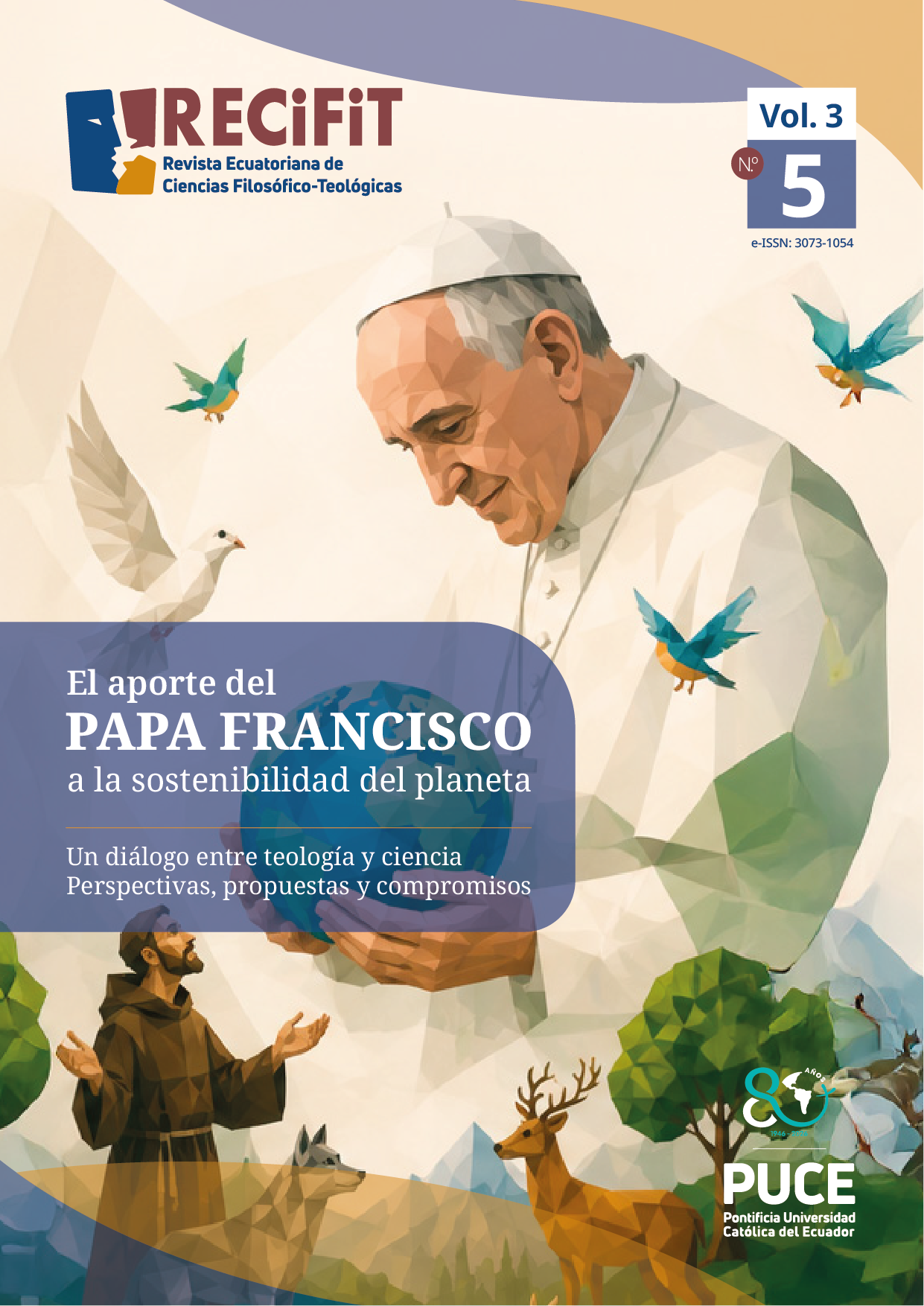
Main Article Content
Abstract
This article examines the critical relevance of the Canticle of the Creatures by Saint Francis of Assisi in the context of the contemporary socio-environmental and technological crisis. Based on the category of the Anthropocene, it is argued that this crisis is not limited to ecological deterioration, but rather expresses an anthropological understanding based on the separation between humanity, technology, and creation. From this perspective, and in dialogue with studies on the Anthropocene, the critique of the technocratic paradigm, and the recent social magisterium of the Church, especially Laudato si' and some interventions by Pope Leo XIV, it is shown how the Franciscan tradition offers an understanding of the world founded on interdependence, shared vulnerability, and fraternity with all created beings. Likewise, the ethical challenges posed by artificial intelligence are examined, particularly with regard to responsibility, justice, and access to knowledge. The study argues that the Canticle retains a significant critical capacity to challenge contemporary logics of domination and to rethink the relationships between ecology, technology, and human dignity.
Downloads
Article Details
Data Availability Statement
Not applicable.
Section

This work is licensed under a Creative Commons Attribution-NonCommercial-ShareAlike 4.0 International License.
Open Access Licence
pen Access Licence
The Ecuadorian Journal of Philosophical-Theological Sciences adheres to the Open Access model in which the contents of scientific publications are freely available in full text on the Internet, without temporary embargoes, and whose editorial production costs are not transferred to the authors. This policy aims to break down the economic barriers that generate inequalities both in access to information and in the publication of research results.
How to Cite
References
Agamben, G. (2013). Altísima pobreza: reglas monásticas y forma de vida (F. Costa, Trad.). Adriana Hidalgo Editora.
Biermann, F., & Lövbrand, E. (2019). Encountering the “Anthropocene”: Setting the scene. En F. Biermann & E. Lövbrand (Eds.), Anthropocene encounters: New directions in green political thinking (pp. 1–22). Cambridge University Press.
Boff, L. (2000). El despertar del águila: ecología, mística y liberación. Trotta.
Chakrabarty, D. (2009). The climate of history: Four theses. Critical Inquiry, 35(2), 197–222. https://doi.org/10.1086/596640
Crutzen, P. J., & Stoermer, E. F. (2000). The “Anthropocene”. Global Change Newsletter, 41, 17–18.
Dalarun, J. (1996). Francis of Assisi and the feminine. Franciscan Institute Publications.
Delio, I. (2003). Simply Bonaventure: An introduction to his life, thought, and writings. New City Press.
Dicasterio para la Doctrina de la Fe. (2024). Declaración Dignitas infinita sobre la dignidad humana. Recuperado de: https://www.vatican.va/roman_curia/congregations/cfaith/documents/rc_ddf_doc_20240402_dignitas-infinita_sp.html.
Floridi, L. (2013). The ethics of information. Oxford University Press.
Francisco. (2015). Laudato si’: Sobre el cuidado de la casa común. Libreria Editrice Vaticana.
Han, B.-C. (2014). La sociedad del cansancio (A. Saratxaga Arregi, Trad.). Herder.
Heidegger, M. (1977). The question concerning technology. En The question concerning technology and other essays (W. Lovitt, Trad., pp. 3–35). Harper & Row.
Laín Moyano, G. (2021). Responsabilidad en inteligencia artificial: Señoría, mi cliente robot se declara inocente. Ars Iuris Salmanticensis, 9, 197–232. https://doi.org/10.14201/AIS202191197232.
Latour, B. (2017). Facing Gaia: Eight lectures on the new climatic regime (C. Porter, Trad.). Polity Press.
Lehmann, L. (1995). Himno a la creación de Dios. Selecciones de Franciscanismo, 71, 179–207.
León XIV. (2025, 27 de octubre). Diseñar nuevos mapas de esperanza: Carta apostólica con ocasión del LX aniversario de la declaración conciliar Gravissimum educationis. Recuperado de: https://www.vatican.va/content/leo-xiv/es/apost_letters/documents/20251027-disegnare-nuove-mappe.html
León XIV. (2026, 21 de mayo). Discurso del Santo Padre León XIV a los nuevos embajadores acreditados ante la Santa Sede. Recuperado de: https://www.vaticannews.va/es/papa/news/2026-05/el-papa-hoy-se-busca-la-paz-con-las-armas-nuevos-embajadores.html
Manselli, R. (1985). San Francesco d’Assisi. Edizioni San Paolo.
Mazurkiewicz, S. (2023). Grounding human rights in human nature. Springer.
Mitchell, M., Wu, S., Zaldivar, A., Barnes, P., Vasserman, L., Hutchinson, B., ... & Gebru, T. (2019). Model cards for model reporting. Proceedings of the Conference on Fairness, Accountability, and Transparency, 220–229. https://doi.org/10.1145/3287560.3287596.
Molina Parra, B. (2025). El universo en alabanza: Estilo, estructura y espiritualidad del Cántico de las Criaturas. Carthaginensia, 41(80), 555–582.
Moore, J. W. (2016). Anthropocene or Capitalocene? Nature, history, and the crisis of capitalism. PM Press.
Pasquale, F. (2015). The black box society: The secret algorithms that control money and information. Harvard University Press.
Quijano, A. (2000). Colonialidad del poder, eurocentrismo y América Latina. En E. Lander (Ed.), La colonialidad del saber: eurocentrismo y ciencias sociales. Perspectivas latinoamericanas (pp. 201–246). CLACSO.
Vauchez, A. (2012). Francis of Assisi: The life and afterlife of a medieval saint (M. F. Schneider, Trad.). Yale University Press.
White, L., Jr. (1967). The historical roots of our ecologic crisis. Science, 155(3767), 1203–1207. https://doi.org/10.1126/science.155.3767.1203