



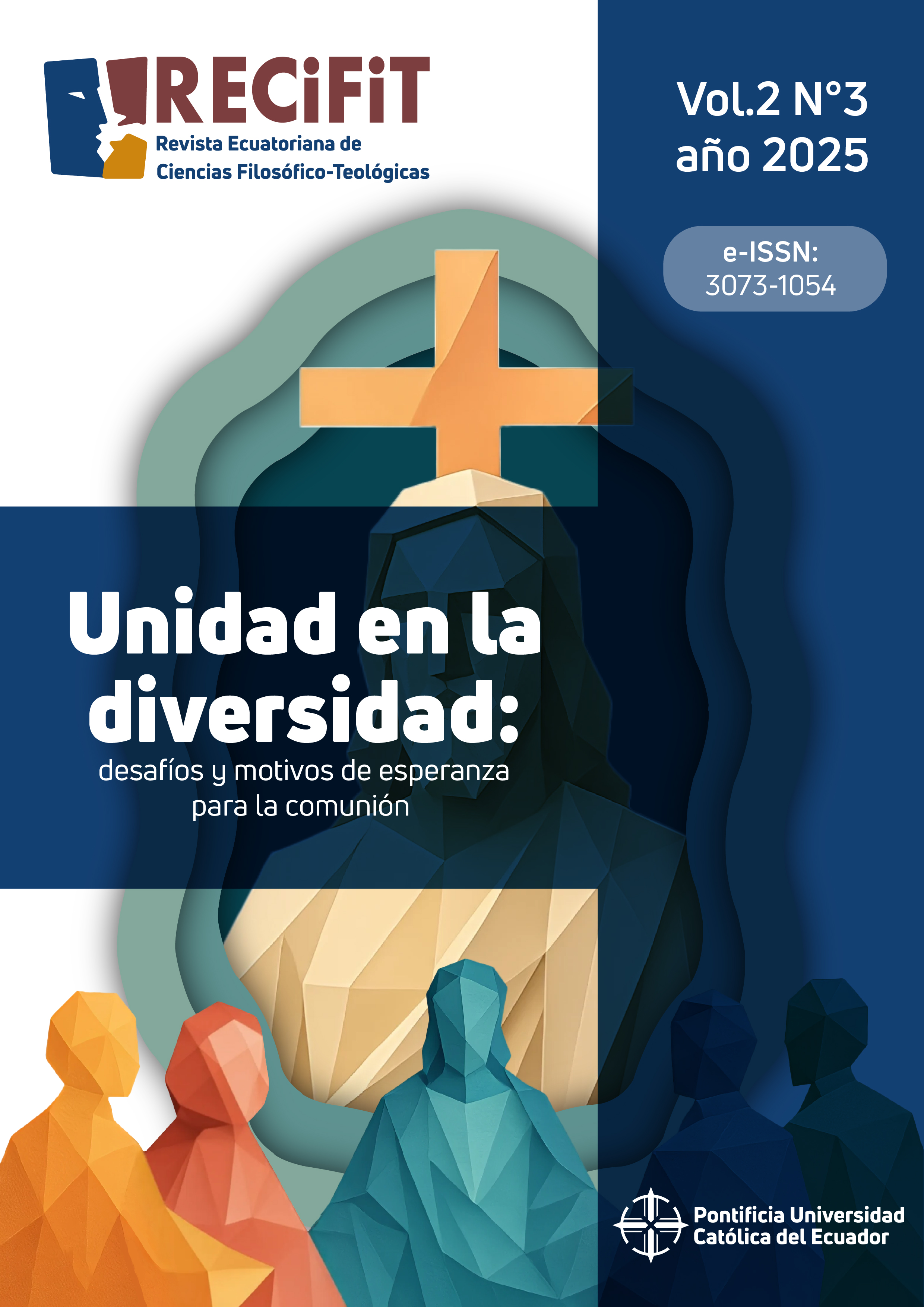
Nicaea is a model for conflict resolution. Communion as a way of dialogue
Article Sidebar
Main Article Content
Abstract
Communion as a way of dialogue, in the context of the 1700 years of the Ecumenical Council of Nicaea (325), aims to analyse how Nicaea can be interpreted as a model for collective conflict resolution, by identifying the principles and dynamics applied in their historical context that may be relevant to contemporary conflict management. Methodologically, a qualitative paradigm is adopted, following the phenomenological hermeneutic method and a descriptive design, through the critical analysis of documents. The results reveal as principles inclusion; open debate; clarity of controversial elements; communion and unity in diversity and consensus. Strategies include the recognition and formulation of conflict; the need to resolve it; dialogue, discernment; logistical support; alternative leadership. In addition, there are values such as humility, commitment, respect for differences and service. It is concluded that communion as a way of dialogue represents an approach based on mutual understanding, empathy and respect for differences, since collaboration was promoted in the search for solutions to theological conflicts by bringing together diverse representatives. Finally, the Council of Nicaea can be interpreted as a useful model for conflict resolution in contexts that require cooperation from various parties with different interests or perspectives.
Downloads
Article Details
Section

This work is licensed under a Creative Commons Attribution-NonCommercial-ShareAlike 4.0 International License.
Open Access Licence
pen Access Licence
The Ecuadorian Journal of Philosophical-Theological Sciences adheres to the Open Access model in which the contents of scientific publications are freely available in full text on the Internet, without temporary embargoes, and whose editorial production costs are not transferred to the authors. This policy aims to break down the economic barriers that generate inequalities both in access to information and in the publication of research results.
How to Cite
References
Durán, Pau M. (23 enero 2025). 1700 años del concilio de Nicea: un hito clave en
la historia del cristianismo. Cataluyna Religio. En
https://www.catalunyareligio.cat/es/1700-anos-concilio-nicea-hito-clave-en-
historia
Enciclopedia Herder https://encyclopaedia.herdereditorial.com/wiki/Concilio
Lomonaco, A. (28 febrero 2025). Concilio de Nicea, fuente y dirección de la
unidad. Ciudad del Vaticano en
https://www.vaticannews.va/es/vaticano/news/2025-02/concilio-de-nicea-
fuente-y-direccion-de-la-unidad.html
López, A. (2023). Historiografía sobre el Concilio de Nicea: el Concilio de Nicea a
la luz de sus historiadores, en Anuario Historia de la Iglesia, 32 (2023), pp.
-48. https://doi.org/10.15581/007.32.003
Pál Tóth (junio, 2018). Comunión y diálogo /1. Revista Mirador. En
https://www.ciudadnueva.com/articulo.php?articulo=2757#
Silva García, G. (julio-diciembre, 2008). La teoría del conflicto. Un marco teórico
necesario. Prolegómenos. Derechos y Valores, vol. XI, núm. 22, pp. 29-43.
Universidad Militar Nueva Granada. Bogotá, Colombia.
Vargas, R. A. (2010). Teoría del conflicto social y postmodernidad. Rev. Ciencias
Sociales 128-129: 63-70 / 2010 (II-III). ISSN: 0482-5276. En: