

Active ecological citizenship: A dialogue between Aristotle and Laudato Si'
Article Sidebar
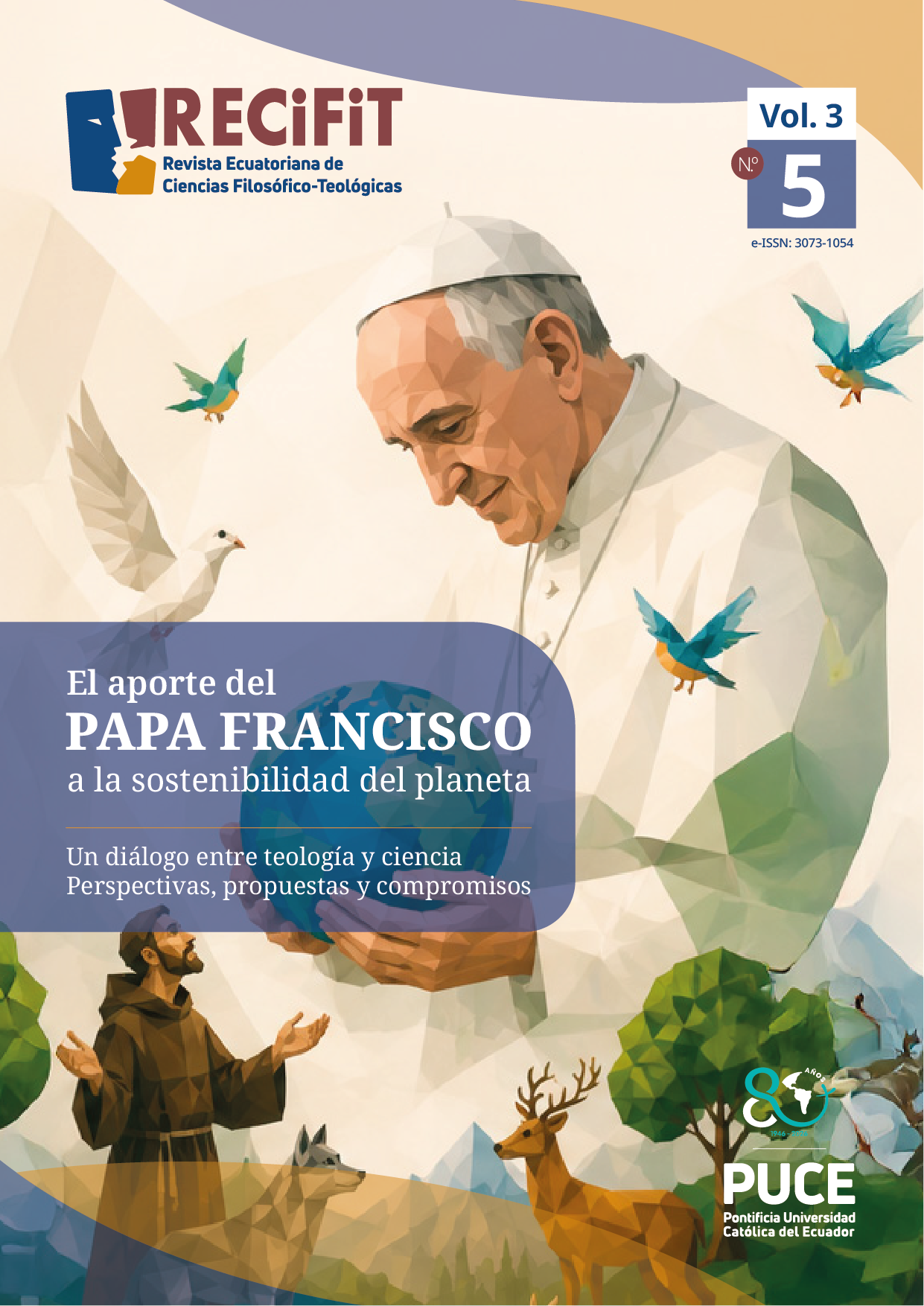
Main Article Content
Abstract
This article proposes a philosophical-theological dialogue between Aristotelian political philosophy and Pope Francis's encyclical Laudato Si', with the aim of grounding the category of "active ecological citizenship" as an integral response to the contemporary environmental crisis. On the occasion of the tenth anniversary of Laudato Si' and the eight-hundredth anniversary of Saint Francis of Assisi's Canticle of the Creatures, it is argued that the ecological crisis is not merely a technical or environmental problem, but rather a profound political crisis, understood as the failure of the political community to orient itself toward the common good. Drawing on the Aristotelian concepts of zoôn politikón (ζῷον πολιτικόν), polis (πόλις), eudaimonía (εὐδαιμονία), and the common good (τὸ κοινὸν ἀγαθόν), reinterpreted through the lens of the integral ecology proposed in Laudato Si', the convergences and tensions between both traditions are analyzed. As a result, the category of active ecological citizenship is proposed, understood as a form of political participation oriented toward the care of our Common Home, environmental justice, the preferential option for the poor, and intergenerational solidarity.
Downloads
Article Details
Section

This work is licensed under a Creative Commons Attribution-NonCommercial-ShareAlike 4.0 International License.
Open Access Licence
pen Access Licence
The Ecuadorian Journal of Philosophical-Theological Sciences adheres to the Open Access model in which the contents of scientific publications are freely available in full text on the Internet, without temporary embargoes, and whose editorial production costs are not transferred to the authors. This policy aims to break down the economic barriers that generate inequalities both in access to information and in the publication of research results.
How to Cite
References
Arendt, H. (2005). La condición humana, Buenos Aires: Paidós.
Aristóteles. (1993). Ética Nicomáquea, Madrid: Gredos.
Aristóteles. (1994). Política, Madrid: Gredos.
Aristóteles. (1995). Física, Madrid: Gredos.
Boff, L. (2011). Ecología: Grito de la tierra, grito de los pobres, Madrid: Trotta.
Cortina, A. (1997). Ciudadanos del mundo: Hacia una teoría de la ciudadanía, Madrid: Alianza Editorial.
Francisco. (2015). Carta Encíclica Laudato Sí: Sobre el cuidado de la Casa Común. Libreria Editrice Vaticana.
Francisco. (2020). Carta Encíclica Fratelli Tutti: Sobre la fraternidad y la amistad social. Libreria Editrice Vaticana.
Francisco. (2023). Exhortación apostólica Laudate Deum: A todos los que habitan nuestra casa común. Libreria Editrice Vaticana.
Gudynas, E. (2011). Buen vivir: germinando alternativas al desarrollo. América Latina en Movimiento, ALAI (462), pp. 1-20. Recuperado de: https://www.flacsoandes.edu.ec/agora/buen-vivir-germinando-alternativas-al-desarrollo
Himes, K. R. (Ed.). (2005). Modern Catholic Social Teaching: Commentaries and interpretations. Georgetown University Press. Recuperado de: https://books.google.com.ec/books?id=H-2mcrdTCg0C&printsec=frontcover&hl=es&source=gbs_atb#v=onepage&q&f=false
Irwin, T. H. (1988). Aristotle's First Principles. Oxford University Press. Recuperado de: https://archive.org/details/terence-irwin-aristotles-first-principles-oxford-university-press/page/n15/mode/2up
Nussbaum, M. C. (2006). Las fronteras de la justicia: Consideraciones sobre la exclusión, Buenos Aires: Paidós.
Ortega Rojas, A. G. (2025). Ciudadanía y democracia: Una resignificación del concepto política en Aristóteles en perspectiva de Fratelli Tutti [Tesis doctoral], Medellín: Universidad Pontificia Bolivariana.